
In the field of industrial solid-liquid separation, the selection of a filter press is a critical engineering decision. Beyond capacity and plate technology, the fundamental structure of the machine – its filterpress design – dictates its operational characteristics, long-term reliability, and suitability for a specific application. The two principal configurations in heavy industry are the side beam filterpress and the overhead beam filterpress.
Choosing between these designs is not a matter of one being universally superior to the other; rather, it is about aligning the specific engineering advantages of each configuration with the unique demands of the process. For plant designers, process engineers, and managers, a clear understanding of this foundational difference is essential for optimizing a dewatering operation for performance and machine longevity.
This technical guide provides a detailed engineering comparison of these two designs. As a manufacturer of both configurations, Diemme Filtration offers this analysis to demonstrate our commitment to providing truly tailored solutions, where the selection of the core machine architecture is the first step in a Custom Engineering process.
The Overhead Beam Filter Press (GHT Series): Engineered for Maximum Scale and Power
The overhead beam filter press is a design synonymous with maximum capacity and extreme structural robustness. As exemplified by the Diemme Filtration GHT and GHT-F series, this configuration is the definitive solution for the most demanding, high-throughput applications in the world.
Core Design Principle
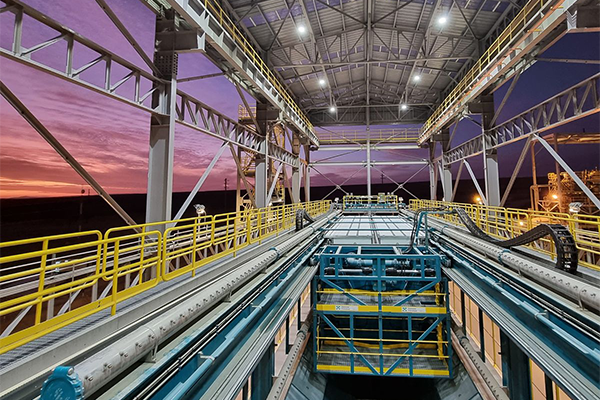
In an overhead beam design, the filter plates are suspended from a large, robust upper beam. The entire weight of the plate pack is supported from above, leaving the area beneath the pack completely open and unobstructed. This simple but powerful concept has profound implications for the machine’s structural integrity and operational capabilities.
Structural Advantages and Load Management
The primary engineering challenge in any large filter press is managing the immense forces of the hydraulic closing system. The GHT series employs a distinctive “pull-to-close” design featuring four powerful hydraulic cylinders positioned at the corners of the plate pack. This works in synergy with the “Total Traction” structural principle:
- Elimination of Beam Stress: The closing force places robust tie beams in pure tension and is not transmitted to the main upper beam. The upper beam’s only function is to support the static weight of the plates. This intelligent design avoids the bending stress that can lead to long-term deformation in other designs.
- Exceptional Rigidity: The upper beam is engineered to be non-deformable, with a maximum deflection of just of its span, ensuring perfect plate alignment and sealing under all conditions.
- Uniform Pressure Distribution: The four-cylinder system guarantees that closing pressure is distributed uniformly across each plate, ensuring a perfect seal and preventing localized stress.
Key Operational Features
The overhead beam design enables several high-performance features:
- High Productivity: GHT filter presses are designed to dewater large volumes of slurry, achieving very low residual moisture values due to their exceptional chamber volume and filtration area.
- Unobstructed Cake Discharge: The open space below the plate pack allows for simple and efficient collection of discharged filter cakes via large bunkers or conveyors.
- Ease of Maintenance: This design provides clear, open access to the filter plates for inspection and filter cloth replacement, making routine maintenance operations simpler and safer.
- Advanced Automation: The robust frame easily accommodates sophisticated automation, such as the carousel-type plate shifting device which provides rapid and sequential plate movement, and robotic high-pressure cloth washing systems.
Ideal Applications
The GHT overhead beam filter press is the undisputed choice for the largest and most demanding applications, particularly in the mining and metallurgy sector for dewatering mineral concentrates and tailings. When a process requires the maximum possible filtration capacity in a single unit – as seen in the Diemme Filtration GHT 2500, one of the world’s largest presses, and the GHT5000F Domino – the overhead beam design is the only viable engineering solution.
The Side Beam Filter Press (ME, Automat, KE Series): The Benchmark for Versatility and Speed
The side beam filter press is the most widely utilized design across a broad spectrum of industries, prized for its versatility, compact footprint, and ability to be configured for a multitude of specific process needs. The plates in this design are supported by heavy-duty beams running along the sides of the machine.
A Family of Specialized Designs
Diemme Filtration has developed a family of side beam presses, each engineered with specific strengths to meet different operational goals. This is a key point of differentiation in a GHT vs ME or Automat comparison; the side beam architecture allows for greater specialization.
- The ME Series (High-Speed & Versatile): The ME filter press is engineered for extreme versatility. Its defining feature is a simultaneous plate-pack opening system. This mechanism allows all filter cakes to be discharged in a very short time, making the ME series ideal for processes with high-filterability products that demand rapid filtration cycles.
- The AUTOMAT Series (User-Friendly & Flexible): The AUTOMAT is designed specifically for user-friendliness, reliability, and the filtration of products with low filterability. Its plate-shifting mechanism utilizes two trolleys with toothed drive belts, providing smooth and quiet operation. The design incorporates advanced safety features like photoelectric light curtains, which allow operators lateral access to the plate pack without stopping the machine, enhancing both safety and usability.
Key Operational Features
- Fully Automatic Operation: Both the ME and Automat series are designed for fully automatic cycles with minimal operator intervention.
- Compact Footprint: For a given capacity, side beam presses can often be designed with a more compact footprint compared to their overhead beam counterparts, a key consideration for installations in existing facilities.
- Customization: The side beam architecture is extremely adaptable, allowing for extensive customization to suit specific client and process requirements.
Ideal Applications
The side beam filter press is a proven workhorse across a vast range of industries, including:
- Chemical & Pharmaceutical
- Food & Beverage
- Dredging & Soil Remediation
- Oil & Gas
- Municipal and Industrial Wastewater
It is the optimal choice for applications where versatility, speed, and a high degree of automation are the primary drivers.
Direct Comparison: Engineering and Application Criteria
The following table provides a direct, at-a-glance comparison of the two designs based on key engineering and application criteria.
| Criterion | Overhead Beam Filter Press (GHT Series) | Side Beam Filter Press (ME/Automat Series) |
| Structural Load Principle | “Pull-to-close” design places tie beams in tension; main beam only supports plate weight, avoiding stress. | Closing force is contained by robust side beams, which are engineered to manage all operational stresses. |
| Maximum Capacity/Scale | Designed for the highest possible throughput and largest capacities in a single unit (up to 2200 ). | Excellent range for small to large capacities, but not intended for the massive scale of the largest GHT models. |
| Cake Discharge Mechanism | Rapid, sequential plate-by-plate opening via a carousel shifter. | Can be configured for plate-by-plate shifting (Automat) or ultra-fast simultaneous pack opening (ME). |
| Access for Maintenance | Completely open access under the plate pack provides excellent space for cake handling and maintenance. | Access can be more constrained by the side beams, but designs are optimized for maintenance activities. |
| Primary Application Focus | Heavy-duty, high-volume applications, primarily mining and mineral processing. | Highly versatile across a wide range of industries requiring speed, flexibility, and automation. |
Conclusion: A Commitment to Custom Engineering
The choice between an overhead beam and a side beam filter press design is a foundational engineering decision that has a lasting impact on an operation’s efficiency and reliability. There is no single “best” solution; the optimal choice is entirely dependent on the specific requirements of the application.
- The Overhead Beam (GHT) design offers unparalleled scale, power, and structural robustness, making it the definitive choice for the world’s largest and most demanding dewatering projects.
- The Side Beam (ME, Automat) design provides exceptional versatility, speed, and a high degree of specialization, making it the ideal solution for a diverse range of industrial processes.
This engineering comparison highlights a core philosophy: the most effective solutions are born from a deep understanding of the process. By offering and expertly engineering both major design configurations, Diemme Filtration ensures that every client receives a solution perfectly tailored to their challenge. This is how we multiply your value and build partnerships where Trust Never Ends.
Frequently Asked Questions (FAQ)
- What is the main structural difference between an overhead beam and a side beam filter press?
The main difference is how the filter plates are supported. In an overhead beam press, the plates hang from a single, large beam above the plate pack. In a side beam press, the plates are supported by two beams that run along the sides of the machine.
- For which industry is a GHT overhead beam filter press typically recommended?
The GHT overhead beam press is typically recommended for the mining and mineral processing industry, where extremely high volumes of slurries like mineral concentrates and tailings require dewatering. Its design is optimized for maximum capacity and heavy-duty, continuous operation.
- What makes the ME side beam press so fast for cake discharge?
The ME side beam press is equipped with a simultaneous plate pack opening system. Instead of opening one plate at a time, this mechanism opens all plates at once in an accordion-style movement, allowing all filter cakes to discharge in a very short period, which is ideal for rapid-cycle applications.
- How does the “pull-to-close” system on a GHT press improve its longevity?
The “pull-to-close” system, part of the “Total Traction” design, uses four hydraulic jacks to pull the headers closed, placing tie beams in tension. This prevents the immense closing force from creating bending stress on the main support beam, which is a primary cause of frame fatigue and deformation in other designs. This superior stress management leads to a longer and more reliable machine life.