In the field of industrial solid-liquid separation, the ultimate objective is often the achievement of maximum cake dryness. A lower residual moisture content in the final filter cake translates directly into lower transportation and disposal costs, higher recovery rates of valuable filtrate, and the production of a geotechnically stable solid material. While standard filter press technology is highly effective, advanced applications demand a higher level of dewatering performance.
This is the domain of the membrane filter press. This advanced configuration introduces a critical mechanical step – cake squeezing – that goes beyond the boundaries of conventional filtration to achieve superior results. Understanding the working principle of this technology is essential for engineers and plant managers seeking to optimize demanding dewatering processes.
This technical guide provides a detailed examination of how a membrane filter press operates, from its core components to the quantifiable benefits it delivers. Diemme Filtration’s commitment to engineering excellence and attention to details ensures the correct application of this powerful technology for our clients’ most challenging separation tasks.
Standard Chamber Press vs. Membrane Filter Press: A Core Distinction
To fully appreciate the membrane press, one must first understand the operation of a standard recessed chamber filter press.
The Recessed Chamber Plate
A standard filter press utilizes a series of recessed chamber plates. When the press is closed, these plates form a series of fixed-volume voids. During the filtration cycle, a slurry feed pump continuously forces the slurry into these chambers. The pressure builds, liquid passes through the filter cloths, and solids accumulate until the chambers are completely filled and compacted by the hydraulic pressure of the feed pump. The cycle ends when the filtrate flow effectively stops. The dryness of the cake is therefore entirely dependent on the characteristics of the slurry and the maximum achievable feed pressure.
The Membrane Plate Advantage
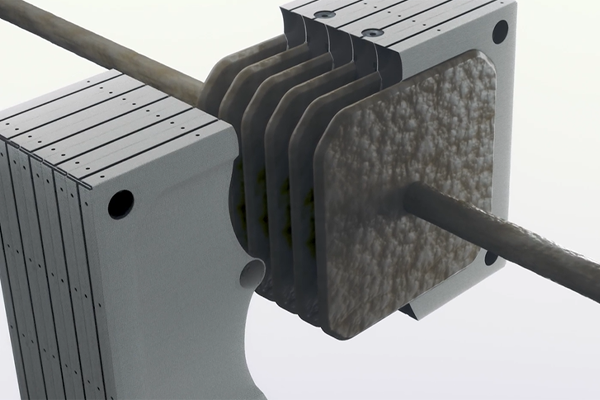
A membrane filter press incorporates a more sophisticated plate design. The membrane plate consists of a solid core body with a flexible, impermeable membrane on one or both faces. This creates a small, sealed chamber behind the membrane surface. The introduction of this flexible membrane allows for an additional and decisive step in the dewatering cycle, fundamentally changing the operational dynamics of the press.
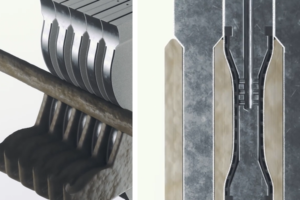
The Step-by-Step Working Principle of a Membrane Filter Press
The operational cycle of a membrane filter press can be broken down into distinct phases. While some phases are common to all filter presses, the “Cake Squeezing” phase is the unique and value-defining step.
Phase 1: Closing
As with a standard press, the cycle begins with the hydraulic system closing the plate pack. The immense force exerted by the hydraulic ram ensures the pack is hermetically sealed, forming a series of empty, watertight filtration chambers ready to receive the slurry.
Phase 2: Filling (Slurry Feed)
The slurry is pumped into the press, flowing through the feed ports and filling all the chambers simultaneously. As the chambers fill, solid particles begin to deposit on the surface of the filter cloths, initiating the formation of the filter cake.
Phase 3: Filtration
The slurry feed pump continues to operate, building pressure within the chambers. This pressure forces the liquid component of the slurry to pass through the filter cloths as clear filtrate, while the solids are retained.
A key operational difference emerges in this phase. Unlike a chamber press that must run until the chambers are completely packed with solids at high pressure, the filtration phase in a membrane press can be stopped earlier. The cycle proceeds only until a reasonably well-formed, but not fully compacted, cake has been established in each chamber. This ability to shorten the filtration phase is a primary contributor to reducing overall cycle times.
Phase 4: Cake Squeezing (The Membrane Inflation Phase)
This is the core of the membrane filter press working principle. Once the initial cake has been formed and the slurry feed pump is stopped, the squeeze phase begins:
- Squeeze Medium Introduction: A squeeze medium – typically compressed air or water – is introduced into the sealed chamber behind the flexible membranes of the plates.
- Membrane Inflation: The pressure of the squeeze medium causes the membranes to inflate and expand outwards into the filtration chamber.
- Mechanical Cake Compression: As the membranes inflate, they physically compress the filter cake that has formed on the cloths. This applies a uniform and high mechanical pressure across the entire surface of the cake.
- Final Dewatering: This direct mechanical squeeze physically wrings out the remaining liquid from the voids within the cake. This additional filtrate passes through the cloths and is discharged, resulting in a filter cake with significantly lower residual moisture. High cake dryness is achieved through this powerful, direct compression.
The pressure exerted during the squeeze phase is independent of the slurry feed pump and can be controlled precisely to achieve the desired level of dewatering for a specific material.
Phase 5: Air Blow (Optional)
For applications requiring the absolute lowest possible moisture content, an optional air blow cycle can be performed after the squeeze phase. Compressed air is forced through the filter cake, displacing even more residual liquid and further enhancing dryness.
Phase 6: Opening and Cake Discharge
Finally, the squeeze pressure is released and the membranes deflate. The hydraulic system retracts, opening the plate pack. Because the cakes are drier and more compact, they typically release from the cloths more cleanly and consistently, falling into the collection system below.
Key Engineering Components and Considerations
The successful application of membrane filter press technology relies on the correct engineering of its specialized components.
Membrane Plate Design and Materials
Membrane plates are composite structures composed of a rigid core – typically manufactured in polypropylene – and a flexible membrane surface. The membrane may be permanently welded to the plate body or designed as a replaceable component. In the latter case, the membrane can be independently replaced, simplifying maintenance and extending the operational life of the plate.
The membrane itself is often made from durable, flexible materials like Thermoplastic Elastomer (TPE) or other specialized polymers. The selection of these materials is a critical engineering decision based on:
- Chemical Compatibility: Resistance to the process slurry and any cleaning chemicals.
- Temperature Resistance: Ability to operate reliably at the process temperature.
- Flexibility and Durability: Ability to withstand thousands of inflation/deflation cycles without failure.
Squeeze Medium and Pressure Control
The choice between water and air as the membrane squeeze medium depends on process conditions, safety requirements, and operational considerations.
- Water Squeeze: Water is commonly used when higher and more uniform pressure transmission is required or when the process operates at elevated temperatures, as hot water can be used as the squeezing medium. In addition, water is often preferred in installations located in potentially explosive environments, where the use of compressed air may not be allowed.
- Air Squeeze: Compressed air can also be used as the squeezing medium and is often preferred for operational reasons. In particular, when compressed air is used, the deflation of the membranes after the squeezing phase is typically faster, allowing a quicker return to the filtration configuration and contributing to shorter cycle times.
A sophisticated PLC-based control system is essential for managing the squeeze cycle, ensuring precise pressure control and seamless sequencing of valves.
The Quantifiable Benefits of Membrane Technology
The unique working principle of the membrane filter press delivers several significant operational advantages over conventional chamber presses.
Achieving Maximum Cake Dryness
This is the technology’s foremost advantage. By physically squeezing the cake, membrane presses can reduce the final moisture content by a significant margin compared to what is achievable with a chamber press operating on the same slurry.
Shorter Cycle Times and Increased Productivity
Since the final dewatering is accomplished by the squeeze phase, the initial slurry pumping (filtration phase) does not need to continue until the final pressure is reached. The feed pump can be stopped once the chambers are 80-90% filled with a soft cake. As this final, slow-pumping stage of the cycle is often the longest, eliminating it can lead to a significant reduction in the overall cycle time—in some cases by 50% or more. This allows for more cycles per shift, dramatically increasing the overall productivity of the press (of dry solids processed per hour per of filtration area).
Improved Cake Washing Efficiency
For applications in the chemical and pharmaceutical sectors where it is necessary to wash the filter cake to remove impurities, membrane technology offers superior performance. After the wash liquid is passed through the cake, the squeeze cycle can be used to efficiently displace the wash liquid from the cake voids. This results in a purer final product and can reduce the consumption of expensive wash water.
Conclusion: A Custom-Engineered Solution
The membrane filter press working principle, centered on the powerful cake squeezing phase, represents a significant advancement in filter press technology. It provides a direct mechanical means to achieve a level of high cake dryness and productivity that is unattainable with standard chamber press designs.
However, the deployment of this technology requires a deep level of process expertise. The decision to use membrane plates, the selection of materials, the configuration of the system, and the optimization of the cycle parameters must all be based on the unique characteristics of the slurry. It is a solution that demands Custom Engineering. By partnering with Diemme Filtration, you gain access to decades of expertise in designing and manufacturing advanced filtration systems that are precisely tailored to your process, ensuring that the full potential of membrane technology is realized to multiply your value.
Frequently Asked Questions (FAQ)
- What is the main difference between a membrane filter press and a chamber filter press?
The main difference is the plate design and an extra step in the operating cycle. A chamber press uses fixed-volume plates and dewaters solely with the pressure from the feed pump. A membrane press uses plates with flexible surfaces that inflate at the end of the filtration cycle to mechanically squeeze the filter cake, physically forcing out additional liquid to achieve a much drier final product.
- What is the “squeeze medium” and how is it chosen?
The squeeze medium is the fluid – either water or compressed air – that is pumped behind the flexible membranes to make them inflate. Water is typically chosen for high-pressure applications where maximum cake dryness is the goal, as it is incompressible and provides uniform pressure.
- Does a membrane filter press always have a shorter cycle time?
In many cases, yes. The overall cycle time can often be reduced because the initial slurry filling stage can be stopped before the chambers are completely packed with solids. The fast and efficient squeeze phase then completes the dewatering. This can significantly shorten the total cycle compared to a standard press, which relies on a long, slow pumping period at the end of its cycle to achieve final dryness.
- In which industries is membrane filter press technology most beneficial?
Membrane technology is most beneficial in industries where maximum cake dryness is critical. This includes mining (for dry stack tailings and concentrate dewatering), municipal and industrial wastewater treatment (to reduce sludge disposal volume), chemical and pharmaceutical production (for product purity and high yield), and any process where minimizing residual moisture provides a significant economic or operational advantage.