Welcome back to our technical column “10+1 things to know when working with filter presses”: a practical space where we share field knowledge and lessons learned from real cases.
Like always, our goal is to promote reliable, responsible operation and help raise the overall competence in the solid-liquid filtration sector.
Focus of the day: A responsible operational approach beats run-to-failure and improvisation
In many plants, filter press issues are not caused by fundamental design errors; they arise from how the equipment is managed daily.
A lack of preventive thinking, ad-hoc fixes, and unstructured maintenance plans often leads to unnecessary downtime, safety risks, and higher overall costs.
Why “run-to-failure” and “urgent procurement” are false economies
Waiting for components to fail before acting may seem cheaper, until you compare it with the real consequences: unplanned stops, expedited parts orders at premium prices, and scrambling for technical support.
Emergencies cause stress on your team and your budget.
A planned spare parts inventory and a proactive procurement strategy protect production continuity and cost stability.
Effective remote support starts with preparation
Remote assistance can be a powerful tool, but only if the plant is prepared with reliable diagnostics, clear data points, and operators who know how to communicate the situation.
Sending screenshots of alarms, historical trends, and process parameters saves time and helps the service team diagnose issues remotely, fast and effectively.
Process intelligence, not just mechanics
Filterpresses are more than steel and hydraulics. Monitoring pressures, cycle times, cloth conditions, cake dryness and filtrate trends gives early insights into emerging issues.
Operators and supervisors who understand the process can prevent problems before they become failures.
A modern and innovative way and service provided by Diemme Filtration is our AIDA IIoT solution.
Your team and maintenance plans are your first line of defense
A well-trained operations team makes a measurable difference.
Training turns experience into consistent, correct action, reducing variability between shifts and mistakes due to assumptions or improvisation.
Similarly, a structured preventive maintenance plan (inspections, lubrications, cleaning schedules) ensures reliability over time.
As an example: waiting for a failure before checking lubrication or plate cleanliness often means replacing parts that could have lasted longer with proper care.
Common oversight: neglecting plate cleaning, sealing surfaces, and upstream processes
Dirty plates, worn sealing areas, and neglected cloths are frequent root causes of leaks, unstable cycles and production issues.
Similarly, problems upstream, like poor feed conditioning or solids distribution, often manifest as filter press malfunctions.
The solution starts with regular cleaning routines and process checks, not with last-minute fixes.
Experiments on the live plant cost you real money
Trying unvalidated settings, shortcuts, or “innovative fixes” without process evaluation often leads to more downtime, unplanned shutdowns, and lost production.
Responsible operators follow documented procedures and standard operating practices instead of relying on ad-hoc experimentation.
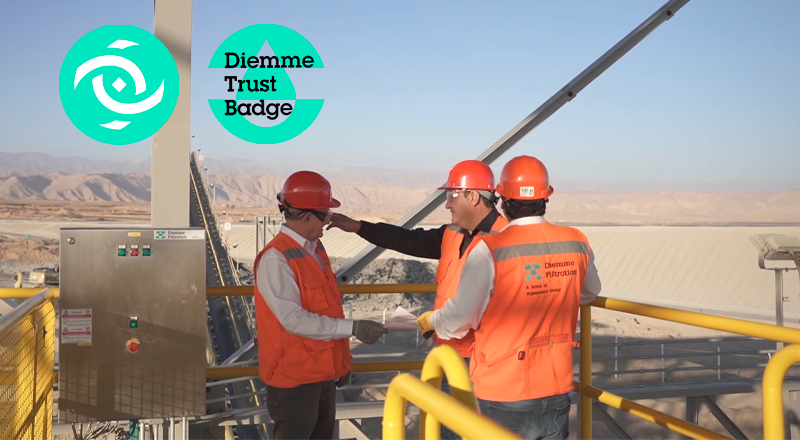
Training, trust and long-term confidence: the Diemme Trust Badge
At Diemme Filtration, we believe that reliable operation starts with knowledge and responsible practices. That’s why we support customers with structured training programs that turn operators into competent professionals.
Operators who complete these programs earn the Diemme Trust Badge, a symbol of verified competency and trust in managing filter presses safely and effectively.
Training isn’t a checkbox: it’s relationship-building between people, equipment, and process that pays off every day in reliability and performance.