The global shift to a low-carbon economy is the most significant industrial pivot of our generation. Electric vehicles, grid-scale battery storage, wind turbines, and solar panels are no longer future-tense concepts; they are present-day realities. But this green revolution stands on a foundation dug from the earth. It is powered by critical minerals: lithium, cobalt, nickel, copper, and rare earths.
The inconvenient truth of the energy transition is that it is fundamentally a mining transition. To build one EV, we must process thousands of kilograms of raw materials. To meet projected 2040 demand, the world will need to mine nearly 40 times more lithium, 25 times more graphite, and 20 times more nickel and cobalt than it did in 2020.
For leaders in the mining and metals industry, this presents a dual challenge. First, how to meet this exponential demand in a way that is economically viable. Second, how to do so in a way that is environmentally and socially sustainable.
The answer to both might be connected to solid-liquid separation.
Diemme Filtration is a foundational partner in the green energy supply chain. Our advanced thickening and filtration technologies are not just part of the process; they are essential to it. They are the critical technology that enables miners to maximize mineral recovery, achieve battery-grade purity, and minimize their environmental footprint by recovering over 90% of process water.
As stated in our 2023 Sustainability Report, Diemme Filtration is actively “committed to maintaining its position as a leader in the filtration technology sector… [and] supporting the energy transition through the use of our equipment to mine and refine lithium and other metals essential for this purpose”.
The Purity Problem: Why Standard Filtration Isn’t Enough
Extracting battery-grade minerals is not like processing iron ore. The challenge is not just separating solids from liquids; it’s separating specific solids from a complex liquid brine or slurry.
Take lithium, for example. Whether extracted from hard-rock spodumene or saline brines, the process involves separating the valuable lithium carbonate or hydroxide from a slurry containing impurities like sodium, calcium, and magnesium. These impurities are disastrous for battery performance. To be “battery-grade,” the final product must achieve purity levels exceeding 99.5%.
This is where Diemme Filtration’s membrane filter press technology could become indispensable.
A conventional filter press (a recessed chamber press) dewaters a slurry by pumping it under pressure into a chamber, forcing the liquid out through a filter cloth. But this process has limitations. It relies solely on the feed pump’s pressure, and the resulting “filter cake” can still retain significant moisture and, with it, dissolved impurities.
The Diemme Filtration membrane filter press introduces a revolutionary second step: Cake Squeezing.
- Filtration Phase: First, the slurry is pumped in to form a soft, permeable cake, but the cycle is intentionally stopped early.
- Squeeze Phase: A flexible, impermeable membrane on the face of the filter plate is then inflated with water or air. This mechanical pressure physically compresses the filter cake, wringing out additional liquid and impurities from deep within its voids.
This squeezing action is critical, but for battery metals, its greatest benefit is how it enables efficient cake washing.
To achieve ultra-high purity, the filter cake must be washed to remove the remaining impure solution. In a conventional press, the wash water “channels” through the cake, following the path of least resistance and leaving large areas of the cake unwashed.
In a Diemme Filtration membrane press, the process is far more effective:
- The initial squeeze creates a uniform, compressed, and perfectly formed cake.
- Wash liquid (like clean water) is then passed through this homogeneous cake, efficiently displacing the “mother liquor” and its dissolved impurities.
- A final membrane squeeze is performed, physically forcing the wash water out and leaving behind a final cake that is not only exceptionally dry but also exceptionally pure.
This capability is what allows producers of lithium carbonate, cobalt hydroxide, and nickel hydroxide cake to meet the stringent, non-negotiable purity specifications of the battery industry.
The Sustainability Problem: Eliminating Tailings Dams
The second great challenge is waste. For every ton of valuable metal produced, many tons of waste, or tailings, are generated. Historically, this liquid slurry waste has been stored in massive “tailings dams,” which are now recognized as one of the mining industry’s greatest environmental and safety liabilities.
The future of sustainable mining is “filtered tailings”, and it is made possible by high-pressure dewatering.
This is the domain of Diemme Filtration’s largest and most robust machines, like the GHT overhead beam filter press. The process is a powerful synergy of our two core product lines:
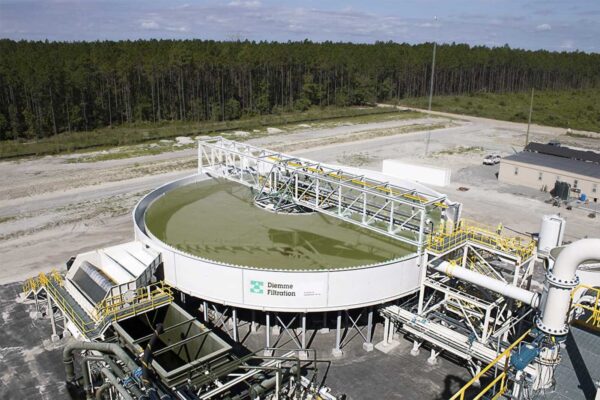
- Thickening: First, the high-volume, low-density tailings slurry is sent to a Diemme Filtration High-Rate Thickener. Using an engineered feedwell and optimized flocculant dosing, the thickener rapidly settles the solids, recovering the vast majority of the process water, which is clean enough to be recycled immediately back to the plant. This is the first and most critical step in water management.
- Dewatering: The thickened underflow – a more concentrated sludge – is then fed to a fleet of GHT-P or GHT-F filter presses.
The result is transformative. Instead of a wet, hazardous dam, the mining operation produces a “spadeable, dry solid material” that can be safely handled, trucked, and “dry stacked”.
This dry-stacking method, enabled by our GHT presses, solves the sustainability challenge:
- Eliminates Tailings Dams: It removes the single greatest long-term environmental risk.
- Maximizes Water Recovery: Over 90% of the process water is captured and recycled, a crucial benefit in the arid, water-scarce regions where lithium and copper are often found.
- Reduces Footprint: Stacked, dry tailings are stable and require a significantly smaller land footprint than a sprawling dam.
- Enhances Safety: The resulting material is geotechnically stable, improving dam safety and supporting progressive mine closure and land rehabilitation.
A Portfolio Engineered for the Energy Transition
Diemme Filtration has engineered a specific portfolio of solid-liquid separation technologies to meet the unique demands of the critical minerals supply chain, from initial bulk separation to final high-purity processing.
| Application Focus | Diemme Filtration Solution | Key Engineering Principle | Primary Benefit to Producer |
| High-Purity Products
(e.g., Lithium Carbonate, Cobalt Hydroxide, Nickel Hydroxide) |
Membrane Filter Presses
(e.g., GHT or ME Series with Membrane Plates) |
Mechanical Cake Squeezing & Washing | Achieves >99.5% Purity. Squeezing creates a uniform cake for highly efficient washing, removing impurities to meet stringent “battery-grade” specifications. |
| High-Volume Concentrates
(e.g., Copper, Zinc) |
Fast-Cycling Filter Presses
(e.g., ME or GHT-F Series) |
Simultaneous Plate Opening | Maximum Throughput. Reduces cycle “technical time” (opening/closing) to an absolute minimum, increasing tons of dry solids processed per hour. |
| Tailings Dewatering
(Dry Stacking) |
High-Capacity Overhead Presses
(e.g., GHT-P, GHT-F & GHT5000F Domino) |
“Total Traction” Structural Integrity | Maximum Reliability & Water Recovery. Engineered for massive scale and 24/7 reliability, producing stable, dry cakes for safe stacking and recycling >90% of process water. |
| Bulk Water Recovery
(Tailings & Concentrate Slurries) |
High-Rate Thickeners | Engineered Flocculation & Settling | Optimizes Entire Circuit. Recovers massive volumes of process water and provides a consistent, high-density feed to the filter presses, dramatically improving their efficiency. |
A Partner in Production, Not Just a Supplier
The challenge of powering the green transition cannot be met with off-the-shelf equipment. Every ore body is different, every brine has a unique chemical profile, and every plant has different economic and environmental goals.
That is why Diemme Filtration’s approach is rooted in Custom Engineering. Our process begins in our advanced laboratories, where we test client slurry samples to determine the precise parameters required for optimal separation. We analyze particle size, settling rates, and flocculant effectiveness to design an integrated system where the thickener and filter press work in perfect synergy.
This philosophy, driven by deep process knowledge, ensures our technology delivers quantifiable value. By designing a holistic system, we multiply the value of your operation, ensuring lower operational costs, greater water recovery, and a reliable solution that solves your unique challenges.
Is your critical mineral project facing dewatering, purity, or tailings challenges?
Contact the solid-liquid separation experts at Diemme Filtration today. Let’s engineer the custom solution that will power your operation and the green transition.