For decades, gravity sludge thickening has been a fundamental unit operation in industrial solid-liquid separation. The core principle is elemental: leveraging the force of gravity to concentrate suspended solids from a dilute slurry. While this traditional thickening process is reliable, its reliance on the natural, unassisted settling of particles presents significant limitations in efficiency and scale for modern, high-throughput industries.
The evolution of this process has led to the development of the high-rate thickener, a sophisticated technology that optimizes and accelerates gravity-driven separation. By introducing precisely engineered hydraulics and advanced polymer chemistry, the high-rate thickener achieves vastly superior performance within a fraction of the physical footprint of conventional systems.
This engineering guide provides a detailed analysis of how high-rate technology enhances the gravity thickening process. We will explore the limitations of conventional methods, the core working principles of high-rate systems, and the critical role of the flocculant in achieving process intensification. At Diemme Filtration, we are oriented to the future, delivering engineered solutions that transform traditional processes into high-efficiency systems.
Understanding the Conventional Gravity Sludge Thickening Process
To appreciate the advancements of high-rate technology, it is essential to first understand the principles and constraints of its predecessor.
The Core Mechanism: Unassisted Settling
A conventional gravity thickener operates based on the principle of free settling. Small, individual solid particles suspended in a liquid will gradually settle downwards due to gravity. The speed of this settling is dictated by factors like particle size, shape, and density, as well as the viscosity of the fluid. In slurries with a high concentration of fine or low-density particles, this natural settling process can be extremely slow.
Design and Limitations of Conventional Thickeners
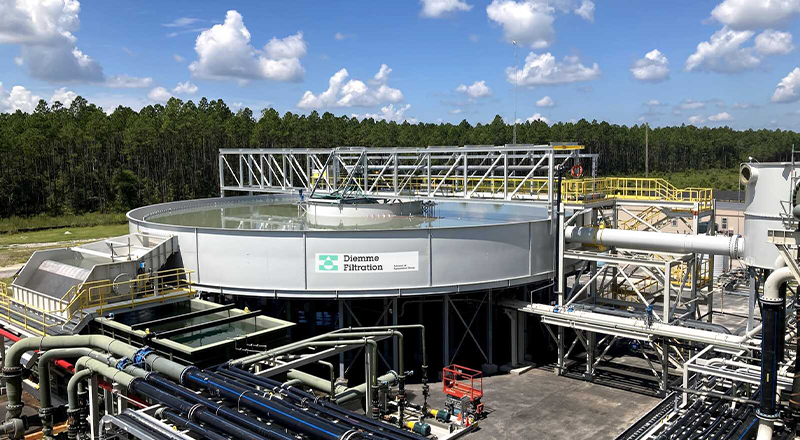
The design of a conventional gravity thickener is a direct consequence of its slow settling rates. They are typically large, shallow, circular tanks with a massive diameter. This large surface area is necessary to provide a quiescent zone and sufficient residence time, often many hours or even days, for the particles to settle out of the solution.
The primary limitations are clear:
- Massive Footprint: They consume a very large amount of plant space, which is a significant capital and operational cost.
- Low Throughput: The volumetric processing capacity relative to their size is very low.
- Inefficiency with Fines: They struggle to effectively capture ultra-fine particles, which can remain in suspension and exit with the overflow, reducing overall separation efficiency.
- Low Underflow Density: The final thickened sludge concentration is often limited due to inefficient compaction.
The High-Rate Evolution: Amplifying Gravity with Flocculation
A high-rate thickener does not defy gravity; it optimizes the conditions under which gravity can act. The revolutionary step is the controlled introduction of a flocculant to fundamentally change the nature of the solid particles.
The Role of the Flocculant
A flocculant is a long-chain polymer designed to neutralize surface charges on suspended solid particles, allowing them to agglomerate. Through a process of bridging, the polymer chains physically link multiple individual particles together, forming larger, more robust aggregates called “flocs.”
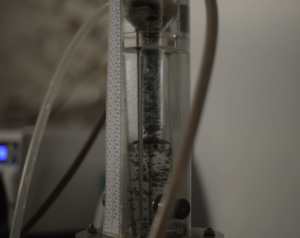
Creating Flocs: The Key to Accelerated Settling
These newly formed flocs have a significantly greater mass-to-drag ratio than the individual particles. This means they settle through the liquid at a dramatically faster rate, often 10 to 100 times faster, under the same force of gravity. This accelerated settling is the core principle behind the high-rate thickening process. The technology does not change the fundamental force at play; it intelligently modifies the particles to make them far more susceptible to that force.
Inside a Modern High-Rate Thickener: An Engineered System
The superior performance of a high-rate thickener is the result of a holistically engineered system designed to perfect the flocculation and settling process. Our attention to details in the design of each component is critical to the system’s overall success.
The Feedwell: The Heart of the Process
The feedwell is where the critical introduction and mixing of the slurry and flocculant occurs. It is far more than a simple inlet pipe. A high-efficiency feedwell is custom-engineered to:
- Dissipate Energy: It calms the turbulent energy of the incoming feed stream to create an environment conducive to floc formation.
- Optimize Mixing: It ensures rapid and thorough dispersion of the flocculant throughout the feed for maximum particle contact.
- Promote Floc Growth: It provides a brief period of gentle agitation that allows the flocs to grow to an optimal size and strength before they are discharged into the main body of the tank.
Distinct Settling Zones for Maximum Efficiency
Once the flocculated slurry exits the feedwell, it enters a tank with distinct operational zones:
- Clarification Zone: The uppermost zone of the tank contains the clearest water. As the flocs settle rapidly, clean water is displaced upwards and eventually overflows into a peripheral launder for collection and reuse.
- Hindered Settling Zone: Below the clarification zone, a pulp bed forms where the concentration of solids is much higher. Here, particles settle as a cohesive mass rather than individually, and water must flow up through the network of solids.
- Compaction Zone: In the lowest zone, the weight of the solids above compresses the pulp bed, squeezing out additional entrapped water and further increasing the density of the underflow sludge.
The Rake Mechanism
A slow-moving rake at the bottom of the thickener serves two purposes. Firstly, it creates channels within the compaction bed, assisting with the release of water. Secondly, it conveys the densest, most compacted sludge to a central discharge cone, from which it is pumped. The drive mechanism for these rakes must be extremely robust; Diemme Filtration engineers rake drives capable of delivering up to 2000 kNm of torque to handle the most demanding high-density sludges.
Comparing Conventional vs. High-Rate Gravity Thickening
The advantages of the modern approach become clear in a direct comparison.
| Feature | Conventional Gravity Thickener | High-Rate Gravity Thickener |
| Core Principle | Unassisted settling of individual particles. | Flocculation-assisted settling of aggregates. |
| Key Technology | Long residence time in a large tank. | Engineered feedwell and flocculant dosing. |
| Footprint | Very Large | Significantly Smaller (up to 80% less area) |
| Settling Rate | Slow | Very Fast |
| Typical Underflow Density | Low to Moderate | High to Very High |
| Particle Size Limitation | Inefficient with fine particles. | Highly effective with fine and ultra-fine particles. |
Applications and Benefits Across Industries
The efficiency of the high-rate gravity sludge thickening process makes it the preferred technology across a range of heavy industries, including mineral processing, industrial wastewater treatment, and chemical production.
Maximizing Throughput and Efficiency
The most immediate benefit is the reduction in size. A high-rate thickener can process the same volume of slurry as a conventional unit that is five times its diameter. This saves immense capital cost in construction and frees up valuable plant real estate.
Enhancing Water Recovery
In an era of increasing water scarcity, the ability to efficiently recover and recycle process water is a critical component of sustainability. The highly clarified overflow from a high-rate thickener represents a valuable stream of recovered water that can be immediately reused, reducing a facility’s raw water intake and discharge volumes.
Optimizing the Entire Solid-Liquid Separation Circuit
The thickening process is rarely the final step. The goal is often to prepare the sludge for a final dewatering stage, typically using high-pressure filter presses. A high-rate thickener excels in this role by providing a consistent, high-density feed to the downstream equipment. This optimization of the thickener underflow improves the efficiency of the entire circuit, leading to shorter filter press cycle times and higher overall plant throughput. This system-wide approach is how we multiply your value.
Conclusion: A Modern Standard in Thickening
The modern high-rate thickener represents a transformative evolution of the traditional gravity sludge thickening process. By intelligently augmenting the power of gravity with engineered flocculation, it overcomes the core limitations of conventional methods, delivering superior performance in a vastly smaller footprint. This technology is a cornerstone of efficient industrial solid-liquid separation, enabling higher throughput, greater water recovery, and enhanced overall process stability.
Achieving these results depends on a solution tailored to the specific process. The design of a high-rate thickener requires deep expertise and Custom Engineering to match the system’s hydraulics and chemistry to the unique characteristics of the slurry.
Frequently Asked Questions (FAQ)
- What is the primary advantage of a high-rate thickener over a conventional gravity thickener?
The primary advantage is process intensification. By using a flocculant to create larger, faster-settling particles, a high-rate thickener can process a much higher volume of slurry in a significantly smaller tank. This results in major savings on capital cost and plant footprint for the same throughput.
- What is a flocculant and why is it essential in a high-rate thickening process?
A flocculant is a specialized polymer that neutralizes the charges on fine solid particles, allowing them to bind together into larger aggregates called “flocs.” This step is essential because these large flocs settle under gravity much faster than individual fine particles, which is the key mechanism that allows high-rate thickeners to be so much more efficient than conventional units.
- Is a high-rate thickener suitable for all types of sludge?
High-rate thickeners are extremely versatile and can be custom-engineered for a wide variety of industrial sludges, from mineral tailings and concentrates to chemical precipitates and wastewater solids. The key is to conduct laboratory and pilot-scale testing to select the correct flocculant and determine the optimal design parameters for the specific slurry.
- How does a high-rate thickener reduce the overall plant footprint?
Because the flocculation-assisted settling process is so much faster than unassisted gravity settling, the slurry does not need to remain in the tank for as long. This reduced residence time requirement means that a much smaller tank volume, and therefore a smaller tank diameter, is needed to achieve the desired degree of solid-liquid separation for a given flow rate.