The mineral processing industry operates on a scale that is difficult to comprehend. Vast tonnages of ore are extracted and processed daily, generating immense volumes of slurries in the form of mineral concentrates and tailings. The efficient and responsible management of these streams through solid-liquid separation is not just an operational necessity – it is a critical factor that defines a project’s economic viability, environmental compliance, and social license to operate.
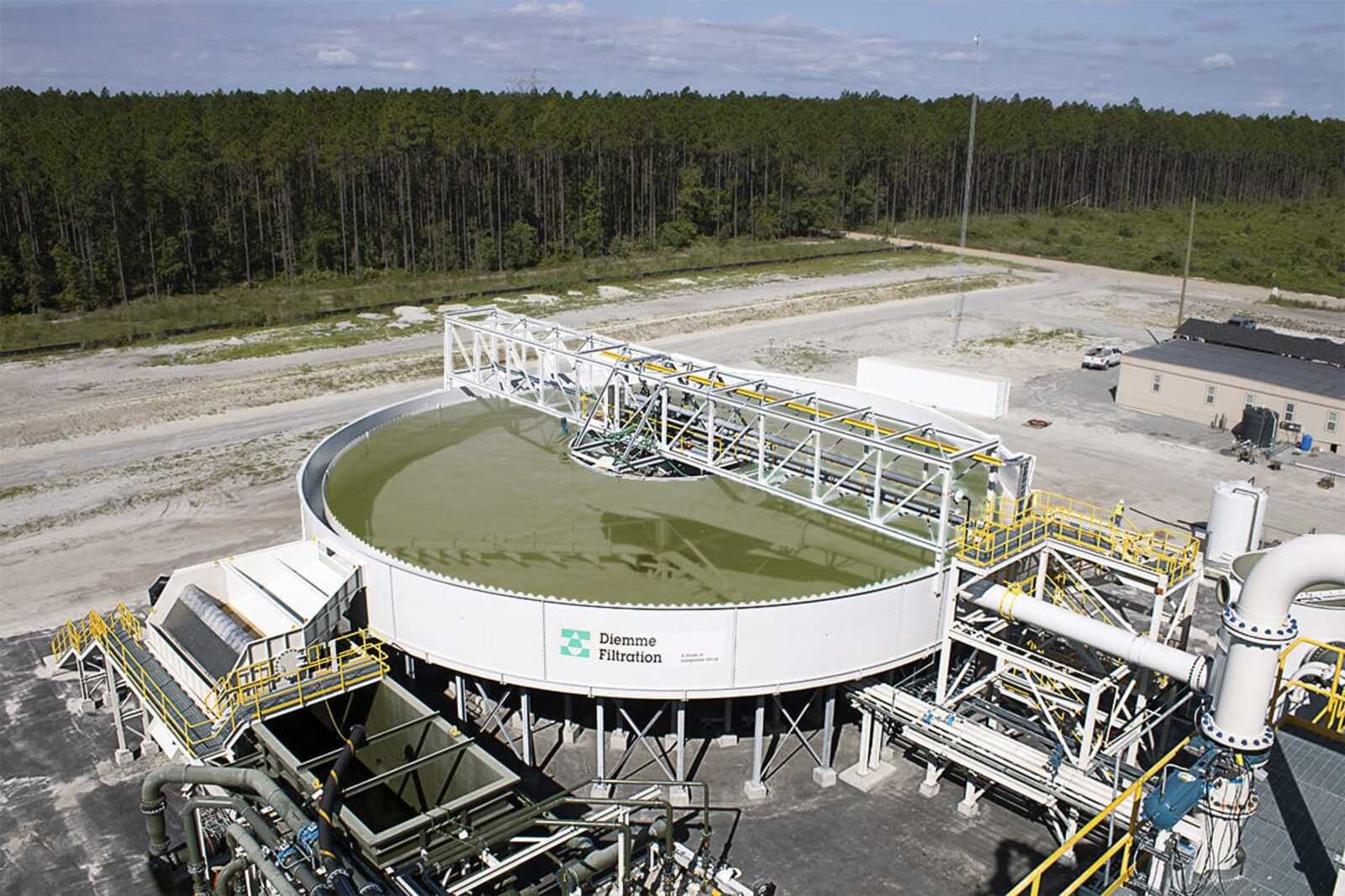
At the forefront of modern sludge thickening technology is the high-rate thickener, an advanced solution engineered to address the specific challenges of the mining sector. Unlike older, conventional methods, high-rate thickeners offer a paradigm shift in efficiency, performance, and physical footprint. They are the cornerstone of effective water management and a crucial preparatory step for final dewatering processes.
This guide provides a definitive technical overview of the high-rate thickener, from its core working principles and key engineering components to its vital applications as a concentrate thickener and tailings thickener. As a company oriented to the future, Diemme Filtration is committed to pioneering technologies that deliver superior performance and long-term value.

The Evolution from Conventional to High-Rate Thickeners
To appreciate the advantages of high-rate technology, it is important to first understand the limitations of conventional thickeners.
Limitations of Conventional Thickeners
Traditional thickeners rely solely on gravity to settle particles out of a slurry. This process, known as free settling, is slow and inefficient, especially for slurries containing a high proportion of fine or ultra-fine particles, which are common in mineral processing. To achieve the required residence time for solids to settle, conventional thickeners require a massive physical footprint, occupying a significant amount of valuable plant space. Their performance is often limited, resulting in a lower-density underflow and less clarified overflow.
The High-Rate Advantage: Engineered Flocculation
The defining innovation of the high-rate thickener is the engineered application of flocculants. By introducing specific polymer chains (flocculants) into the feed slurry under controlled conditions, the microscopic solid particles are drawn together to form larger, heavier aggregates known as “flocs.”
This process of flocculation dramatically increases the particle settling velocity – often by orders of magnitude. This accelerated settling means that a much smaller tank diameter is required to process the same volumetric throughput, leading to a significant reduction in CAPEX and plant footprint. This leap in efficiency is what makes the high-rate thickener the standard for modern mineral processing plants.
Working Principle of a High-Rate Thickener
A high-rate thickener is a sophisticated piece of process equipment designed to optimize flocculation and create distinct operational zones within a single tank. The process is continuous and highly automated.
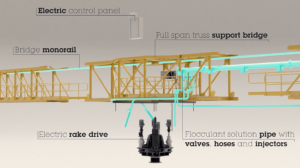
Step-by-Step Process Flow
- Feed Introduction and Flocculation: The dilute slurry feed is introduced into a specially designed feedwell located at the center of the thickener. Simultaneously, a precisely metered dose of flocculant is added. The feedwell is engineered to dissipate the energy of the incoming stream and provide gentle mixing, ensuring optimal contact between the polymer and the solid particles without breaking the fragile flocs once they form.
- Aggregate Formation and Settling: As the flocculated slurry exits the bottom of the feedwell, the newly formed heavy aggregates settle rapidly downwards. The liquid component, now largely free of solids, moves upwards into the clarification zone.
- Pulp Bed Formation: The settling solids accumulate to form a distinct interface between the clearer liquid above and a denser pulp bed below. This pulp bed acts as a natural filter, capturing finer, un-flocculated particles as they descend, further clarifying the rising water.
- Compaction and Water Release: Within the lower compaction zone, the weight of the solids above compresses the pulp bed. This action forces out additional entrapped water, which then migrates upwards. A slow-moving rake mechanism aids this process by creating channels for the water to escape, further increasing the underflow density.
- Underflow Discharge: The rakes slowly convey the highly thickened sludge towards a central discharge cone at the bottom of the tank. From here, it is pumped away as the final thickener underflow, ready for the next stage of the process.
- Clarified Overflow: The clear water from the clarification zone spills over the top of the tank into a peripheral launder. This clarified overflow is then collected and typically recycled back into the plant as process water, a critical component of a sustainable mining operation.
Key Design and Engineering Components
The performance of a high-rate thickener is not merely a function of its size, but a result of the precise design of its core components. Diemme Filtration’s attention to details in engineering each element is fundamental to achieving optimal and reliable performance.
The Feedwell System
The feedwell is arguably the most critical component. Its design must be tailored to the specific flow rate and characteristics of the process slurry. An optimized feedwell ensures efficient flocculant mixing, promotes floc growth, and introduces the flocculated feed into the tank with minimal velocity to prevent disruption of the settling bed. Features like auto-dilution, where clarified overflow water is used to dilute the feed stream to an optimal solids concentration for flocculation, are often incorporated.
Rake and Drive Mechanism
The rake mechanism serves the dual purpose of conveying the compacted sludge to the discharge cone and assisting in the dewatering process within the compaction bed. The drive head must be robustly engineered to handle the immense torque required to move high-density sludges, especially in the event of a process upset. Diemme Filtration custom designs and manufactures rake drives capable of delivering up to 2000 kNm of torque, ensuring reliability in the most demanding applications.
Structural Design: Bridge vs. Column Support
The structural configuration of the thickener is chosen based on its diameter and operational requirements. Diemme Filtration offers two primary designs to suit a wide range of applications:
- Elevated bridge-supported thickeners: Ideal for small to medium diameters, typically up to 35 meters.
- Elevated column-supported thickeners: Used for larger installations, with diameters reaching up to 55 meters.
This flexibility in Custom Engineering allows for a solution that is structurally optimized for the specific project site, taking into account factors like wind and seismic conditions.
Instrumentation and Control
Modern high-rate thickeners are highly automated. A suite of instruments provides real-time data to the plant’s control system, allowing for continuous optimization. Key sensors include:
- Bed Level Transmitters: To monitor the depth of the pulp bed.
- Bed Mass Sensors: To measure the density or pressure within the compaction zone.
- Turbidity Meters: To monitor the clarity of the overflow.
- Rake Torque Sensors: To monitor the load on the drive mechanism and prevent overload.
- Flow Meters: To monitor and manage the flows (inlet, outlet, polymer dosage, etc.)
This data is essential for automatically adjusting variables like flocculant dosage and underflow pump speed to maintain stable and efficient operation.
Applications in Mineral Processing
High-rate thickeners are indispensable tools in modern mineral processing circuits, used in two primary applications: tailings management and concentrate handling.
Tailings Thickener: The Cornerstone of Water Management
For every ton of valuable metal produced, many tons of waste rock and process effluents, known as tailings, are generated. A tailings thickener is the first and most critical step in managing this large-volume waste stream.
- Objective: To recover the maximum amount of process water from the tailings slurry before it is sent to a tailings storage facility (TSF) or to a final dewatering plant, which often uses high-pressure filter presses.
- Benefits:
- Maximum Water Recovery: Reduces the plant’s raw water demand, a crucial benefit in arid regions and a core component of sustainable mining.
- Smaller TSF Footprint: Sending a lower volume of water to the TSF reduces its required size and the associated capital costs and environmental footprint.
- Improved Dam Safety: A higher-density slurry consolidates more effectively, contributing to the geotechnical stability of the TSF.
- Optimized Feed for Dewatering: Provides a consistent, high-density feed for final dewatering technologies like filtration, which is necessary for dry stack tailings.
Concentrate Thickener: Optimizing Downstream Value
After the valuable minerals have been separated from the ore, they exist as a dilute slurry. A concentrate thickener is used to increase the solids percentage of this valuable stream.
- Objective: To dewater the mineral concentrate to an optimal density for downstream processes like filtration, drying, or direct pumping to a port or smelter.
- Benefits:
- Stable Filter Feed: Provides a consistent, high-density feed to the final dewatering stage (typically filter presses), improving their performance and throughput.
- Reduced Equipment Size: Reduces the volumetric load on expensive final dewatering and drying equipment.
The strategic use of high-rate thickeners in these applications is fundamental to how we multiply your value within a mineral processing plant.
Conclusion: An Engineered Solution for Peak Performance
The high-rate thickener is a clear example of how process intensification can deliver transformative results in the mineral processing industry. By leveraging the principles of engineered flocculation, these machines achieve superior sludge thickening performance with a fraction of the footprint of conventional systems. They are essential tools for maximizing water recovery, reducing the environmental impact of tailings, and optimizing the efficiency of the entire processing circuit.
However, a high-rate thickener is not an off-the-shelf product. Achieving peak performance requires a deep understanding of the specific slurry characteristics and process goals. It is a solution born from Custom Engineering, where every component, from the feedwell to the rake drive, is designed and selected to meet the unique demands of the application. This commitment to tailored solutions ensures reliability, efficiency, and a partnership where Trust Never Ends.
Frequently Asked Questions (FAQ)
- What is the main difference between a conventional thickener and a high-rate thickener?
The main difference is the use of flocculants. A conventional thickener relies only on the natural gravity settling of individual particles, which is very slow and requires a large tank. A high-rate thickener introduces flocculants to bind small particles into larger aggregates, dramatically increasing the settling speed and allowing for a much smaller, more efficient design.
- How does a high-rate thickener improve water recovery in mining?
A high-rate thickener separates the tailings slurry into two streams: a highly clarified overflow and a dense underflow. The clarified overflow contains the vast majority of the process water, which is clean enough to be recycled directly back into the processing plant. This significantly reduces the amount of fresh water the mine needs to source, which is critical for both environmental sustainability and cost control.
- What factors are considered when designing a tailings thickener?
The design of a tailings thickener is a complex process based on extensive testing and analysis. Key factors include the required throughput (tons per hour), the ore mineralogy, particle size distribution, slurry pH, and the settling characteristics of the tailings. This data is used to determine the required unit area (m2/ton dry solids/h), tank diameter, rake torque requirements, and optimal flocculant selection and dosage.
- Can a thickener be integrated with a filter press plant?
Absolutely. In fact, this is the ideal configuration for achieving maximum water recovery and producing dry, stackable tailings. The high-rate thickener performs the initial bulk water removal, providing a consistent, high-density feed that allows the downstream filter presses to operate at their highest efficiency, minimizing cycle times and maximizing cake dryness. Diemme Filtration specializes in designing these fully integrated thickening and filtration circuits.